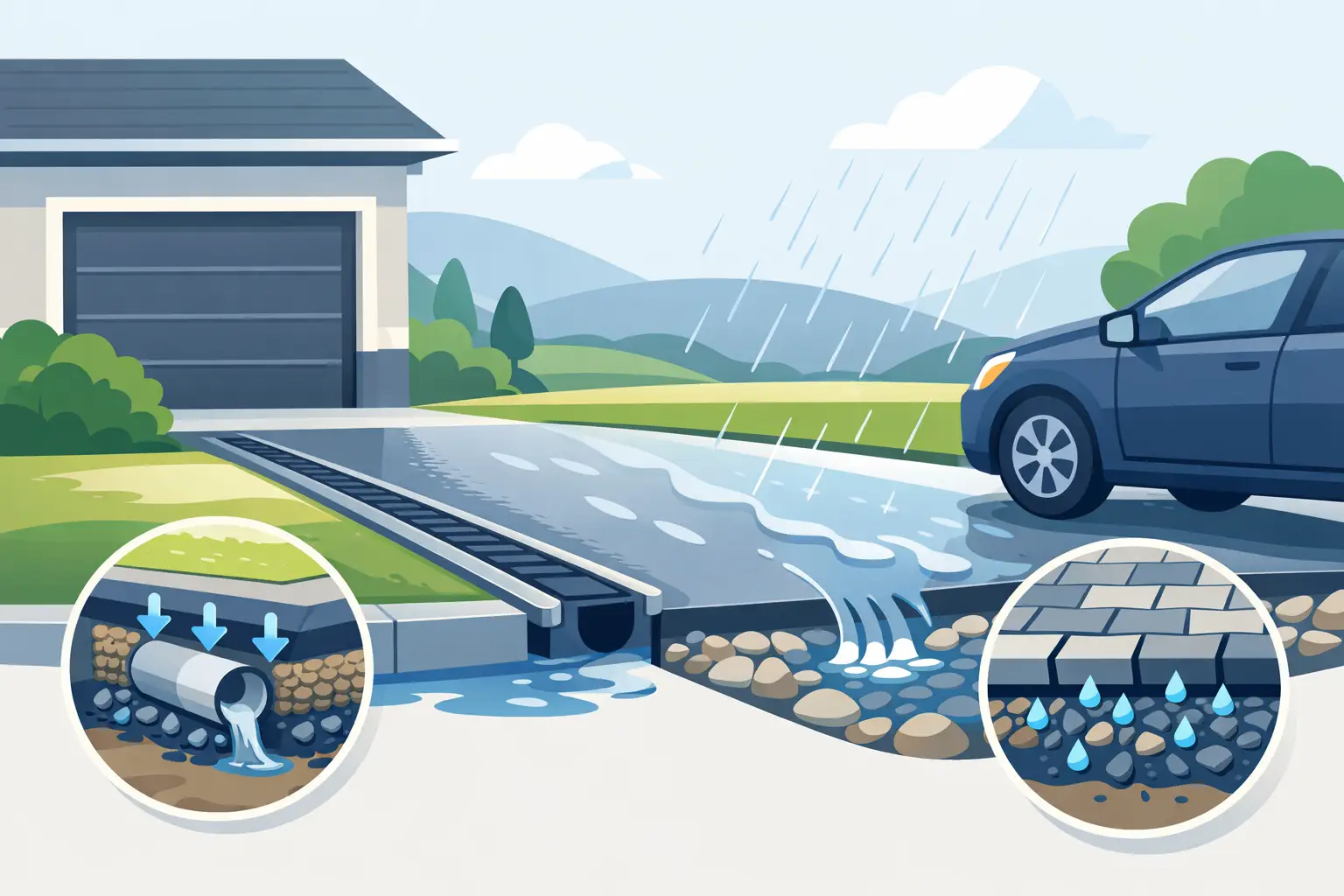
Water should leave a driveway quietly and predictably. When it pools at the front door, runs towards a garage, washes gravel into the road or leaves slippery patches after rain, the issue is usually below the surface rather than a simple nuisance. Knowing how to improve driveway drainage starts with identifying where water is coming from, where it is collecting and where it can safely drain.
For homes across Dublin and Wicklow, this matters especially on older driveways with tired tarmac, compacted gravel or paving that has settled over time. A proper solution protects the property, improves the appearance of the entrance and avoids repeating the same patch repair after every wet spell.
Start by finding the cause of standing water
Before choosing a drain or new surface, inspect the driveway during rain or shortly afterwards. Follow the water from the roof, pavement and driveway entrance. The visible puddle is not always the actual problem. Water may be travelling from a blocked gully, a downpipe that discharges too close to the drive, or a neighbouring higher level.
Look for low points, cracks, sunken paving, moss growth and gravel that repeatedly shifts into one area. These are useful signs that water is sitting there for too long. Check channel drains and gullies for leaves, silt and debris too. A blocked drain can make an otherwise well-built driveway appear to have a major drainage fault.
The ground conditions also matter. Heavy or compacted soils absorb water slowly, while a driveway built over poor or damaged sub-base may hold water even where the finished surface looks fairly level. This is why simply adding a drain to the lowest point does not always solve the issue. The water still needs a planned route into that drain and an appropriate outlet.
Correct the fall before adding drainage
A driveway needs a controlled fall – a gentle slope that directs water away from the house, garage and other vulnerable areas. It should not be so steep that water gathers speed, strips loose aggregate or flows onto the public footpath. The right level depends on the length of the driveway, the surface type, access requirements and existing ground levels.
Minor local settlement can sometimes be corrected by lifting and relaying paving or rebuilding a small section. Where the driveway has widespread dips, poor falls or a failing foundation, a full excavation and regrading is normally the sounder investment. It allows the contractor to establish levels correctly from the outset rather than trying to disguise an underlying problem.
This groundwork is particularly important when replacing an impermeable driveway. If rainwater has historically been directed towards the road or a property boundary, a new surface should be designed to keep drainage managed within the site where required. A professional survey can assess the available levels and recommend a practical drainage route before any surfacing is laid.
Keep roof water separate where possible
Downpipes can overwhelm a driveway quickly during heavy rain. If several downpipes discharge onto the same area, even good falls may not cope. Redirecting roof water to a suitable soakaway, drainage connection or planted area can reduce pressure on the driveway drainage system.
The correct arrangement depends on the property and local drainage options. The key point is to avoid directing concentrated roof water across the finished drive or straight towards the building.
Choose the right drainage method for the site
There is no single best drain for every driveway. The solution should suit the amount of water, the available outlet, the surface construction and the levels around the property.
A channel drain is often effective across the entrance to a garage, at the bottom of a slope or where a driveway meets a patio. It captures surface water before it reaches a threshold. However, channels need a proper fall, secure installation and regular clearing. A channel installed flat, or connected to nowhere suitable, will soon fill with silt and become another maintenance issue.
A soakaway can be a good option where ground conditions allow water to disperse gradually within the property. Its size and location need to be considered carefully, particularly near foundations, boundaries and existing services. In slow-draining ground, a soakaway may need to be larger than expected or may not be the right answer on its own.
For long drives or areas that receive substantial runoff, a combination of regrading, channel drainage and permeable surfacing often produces the most reliable result. It deals with water at the surface while giving rainfall more than one route away from the driveway.
Improve driveway drainage with a permeable surface
Permeable surfacing is one of the most effective ways to improve driveway drainage without filling the entrance with visible gullies. Instead of forcing all rainfall across the top of the driveway, the surface allows water to pass through into a specially designed permeable base below.
Resin bound surfacing is a strong option for homeowners who want a clean, contemporary finish with practical drainage benefits. The natural aggregate is mixed with resin and laid as a smooth, porous layer. When installed over the correct open-graded base, rainwater drains through rather than sitting on top.
The construction beneath the surface is what makes the difference. A permeable driveway needs suitable aggregate layers, correct compaction and carefully planned edge restraints. Laying resin bound material over a dense or cracked base may improve the appearance, but it will not deliver the intended drainage performance. This is one reason full project management – including excavation, base preparation, drainage and final surfacing – is valuable on a drainage-led upgrade.
Permeable tarmacadam and properly constructed gravel driveways can also work well. Gravel is naturally free-draining, but it needs a stable sub-base and an appropriate edging system to prevent migration. It can require more routine attention than resin bound surfacing, particularly on sloped entrances or properties with frequent vehicle use.
Do not overlook maintenance
Even the best drainage design needs occasional maintenance. Sweep leaves, soil and hedge cuttings away from channels and gullies, especially in autumn. Clear surface debris before it is washed into drainage points, and check that downpipe shoes have not become loose or blocked.
For resin bound driveways, regular sweeping and gentle cleaning help keep the pores clear. Avoid coating the surface with unsuitable sealants or allowing soil to build up in shaded areas, as both can reduce permeability over time. If a new puddle develops on a previously free-draining drive, arrange an inspection rather than assuming the surface has failed. The cause may be a blocked outlet, a damaged drain or settlement in an adjacent area.
Gravel driveways benefit from occasional raking and topping up, but repeated washout is a warning that the fall, edging or drainage design needs attention. Adding more gravel alone will not stop water from taking the same path during the next downpour.
When a full driveway rebuild is the better choice
Small drainage improvements are worthwhile when the driveway structure remains sound. Clearing drains, adjusting a downpipe or repairing one settled section can make a real difference. But if water pools across several areas, the surface is cracked, the sub-base has failed or the driveway slopes towards the house, piecemeal repairs can become false economy.
A full rebuild provides the opportunity to remove unsuitable material, create correct levels, install drainage where it is needed and choose a surface that suits the property. It also gives homeowners a clearer long-term result, rather than an entrance made up of visible patches and temporary fixes.
Before work begins, ask for the drainage plan to be explained in plain terms. You should understand where water will go, how the driveway will fall, what materials will be used beneath the finished surface and what maintenance will be needed. An itemised quotation is useful here, as drainage and groundwork should not be treated as an afterthought.
For Dublin and Wicklow properties, Resin Bound Dublin can assess the existing driveway, ground levels and drainage requirements as part of a full installation plan. The aim is not simply to lay an attractive new surface, but to build an entrance that performs properly through Irish weather.
A dry, usable driveway is rarely the result of one quick fix. It comes from giving rainwater a clear route, a stable base and a surface designed to work with it rather than against it.
Leave a Reply