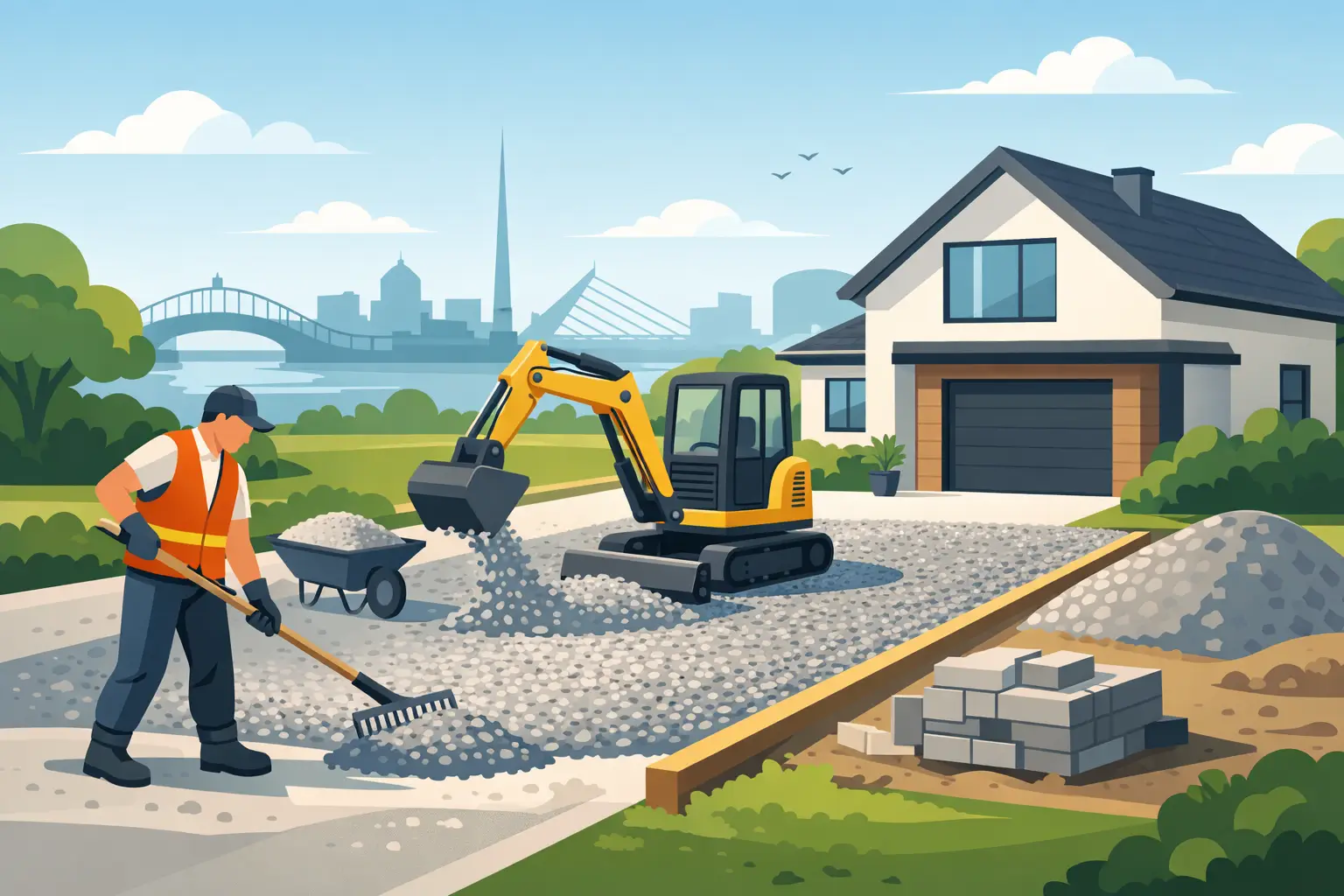
A gravel driveway can look straightforward, but the finished surface is only as good as the ground beneath it. For homes in Dublin and Wicklow, where frequent rainfall and soft ground conditions can expose poor workmanship quickly, a proper gravel driveway installation guide starts with excavation, drainage and a well-compacted foundation – not simply tipping stone onto an existing surface.
Gravel remains a popular choice for homeowners who want a natural appearance, flexible design options and a surface that can work well with a property’s drainage. It can also be a cost-effective alternative to resin bound surfacing or tarmacadam. However, it needs the right preparation to avoid ruts, puddles, loose stone spreading onto the pavement and ongoing maintenance.
What a Good Gravel Driveway Needs
A durable gravel driveway is built in layers. The visible gravel is the final finish, but the structural work below it carries vehicles, controls water and keeps the surface level over time.
The specification depends on the site. A lightly used driveway for one family car does not need the same construction as a wide entrance used by vans, delivery lorries or multiple vehicles. Existing ground conditions matter too. Clay-heavy soil, a sloping site or an area with standing water may require deeper excavation, additional drainage or a stronger sub-base.
The key components are a stable formation level, a geotextile membrane where required, a compacted crushed-stone sub-base, secure edging and a suitable gravel finish. If any of these are overlooked, even premium decorative stone can soon become untidy.
Gravel Driveway Installation Guide: The Proper Process
1. Surveying the driveway and planning drainage
Before work begins, the driveway should be measured and assessed for levels, access, water flow and the condition of the existing ground. This is when a contractor identifies whether surface water can drain naturally into suitable ground or whether channels, drainage runs or soakaway solutions are needed.
A gravel surface is naturally permeable, but that does not automatically mean every driveway will drain effectively. Water must have somewhere to go through the sub-base and into the ground. On compacted clay or poorly draining soil, water can sit beneath the stone unless the drainage design is addressed from the start.
Driveway falls should direct water away from the house, garage and neighbouring property. This is particularly important where an entrance slopes towards the home. Good drainage is not an add-on – it is part of the groundwork.
2. Excavation to the correct depth
The existing surface, vegetation, soil and weak material are excavated to create room for the new construction. For many domestic gravel driveways, this may involve digging out approximately 200mm to 300mm below the finished level, although the final depth depends on ground conditions and expected traffic.
Excavation is also the stage where levels are set accurately. The finished driveway should sit neatly against paths, kerbs, gates and thresholds without creating a step or allowing gravel to spill into surrounding areas.
Simply laying gravel over grass, soil or old broken concrete usually causes problems. The gravel mixes with the ground, wheels create depressions and weeds can work through. Proper excavation gives the driveway a clean, stable starting point.
3. Installing a geotextile membrane
Where ground is soft or soil is likely to migrate upwards, a geotextile membrane is laid over the prepared ground. This separates the sub-base from the soil beneath while allowing water to pass through.
The membrane helps prevent the crushed stone foundation from sinking into the subgrade and reduces the risk of soil contaminating the driveway layers. It is especially worthwhile on clay, wet ground or areas that have previously shown signs of movement.
Not every site needs the exact same membrane or specification. The important point is that the material is selected for the condition of the ground rather than treated as a one-size-fits-all solution.
4. Building and compacting the sub-base
The sub-base is the structural core of the driveway. Crushed aggregate, commonly a well-graded stone such as Clause 804 material, is spread in controlled layers and compacted using suitable machinery.
For a standard residential driveway, a compacted sub-base around 150mm deep is often appropriate, but deeper construction may be needed for weak ground or heavier vehicle use. Compaction should happen in layers rather than attempting to compact one deep loose layer at the end. This produces a firmer base and reduces the chance of future settlement.
A well-built sub-base is what keeps a gravel driveway from becoming uneven after a wet winter. It also provides a free-draining foundation when designed with the correct aggregate and falls.
5. Fitting driveway edging
Edging gives a gravel driveway its definition and holds the stone in place. Depending on the property, this may be concrete kerbing, granite setts, block edging, timber edging or another durable border that suits the look of the home.
Without a firm edge, tyres gradually push gravel outwards and the driveway loses its crisp line. This is most noticeable at turning points, by gates and where cars reverse or manoeuvre regularly.
Edging should be installed at the correct height. It needs to retain the gravel while still allowing easy movement into the driveway and a neat transition to paths or planted areas.
6. Laying the finishing gravel
The final gravel is normally laid at a depth of around 40mm to 50mm. Angular gravel is generally a better choice than rounded decorative pebbles because the pieces interlock more effectively underfoot and under tyres.
A 14mm to 20mm stone is often suitable for domestic driveways. Smaller stone can travel more easily and may get caught in tyre treads, while larger stone can feel difficult to walk on. The right size also depends on the desired appearance and whether the driveway will be used by pedestrians, pushchairs or wheelie bins as well as vehicles.
Colour is a practical consideration as well as a design choice. Pale gravel can brighten a front garden but may show dirt more readily. Darker tones can suit traditional brickwork and often look less marked, while warm golden blends remain a popular choice for rural and suburban properties.
Should You Use Gravel Stabilisation Grids?
Gravel grids are not essential on every driveway, but they can be a sensible upgrade in certain areas. The cellular panels help keep gravel in place, reduce tracking and create a more stable feel under tyres and feet.
They are particularly useful on slopes, busy turning circles, parking bays and driveways used by people with limited mobility. They can also reduce the amount of routine raking needed. The trade-off is a higher initial cost and the need for precise preparation so the grid system sits on a level, well-compacted base.
For a flat driveway with modest use, quality edging, angular stone and a strong sub-base may be enough. For a larger driveway where gravel movement would become a regular annoyance, stabilisation grids can be money well spent.
Common Problems and How to Avoid Them
Most gravel driveway failures come back to insufficient groundwork. A driveway that develops potholes, soft patches or standing water often has a weak base, poor drainage or inadequate excavation beneath it.
Weed growth is another common concern. A membrane can limit weeds coming from below, but airborne seeds can still settle in the surface gravel. Occasional weeding or treatment may be required, particularly near hedges and planting beds. Gravel is low-maintenance, not maintenance-free.
Stone migration is normal to a degree, especially close to entrances and areas where cars turn. Keeping a small amount of matching gravel for periodic topping up helps maintain the finish. Choosing angular gravel, fitting solid edging and avoiding an overly deep loose top layer will all make a noticeable difference.
It is also worth considering snow, leaf fall and cleaning. A leaf blower can be more practical than a rake in autumn, while snow shovels should be used carefully to avoid removing the top stone. These are small operational details, but they affect how satisfied you will be with the surface over the long term.
Choosing a Contractor for the Groundwork
Ask how the driveway will be excavated, what depth of sub-base is proposed, how drainage will be handled and what edging will retain the gravel. An itemised quotation should make clear what is included, from waste removal and lorry access through to final stone depth and site clean-up.
The lowest quote can be misleading if it leaves out excavation, membrane, drainage or proper compaction. Those are the elements that determine whether the driveway remains tidy after years of rain, traffic and seasonal movement. A full-service contractor should manage the work from the first site assessment to the final finish, rather than leaving you to organise groundwork separately.
Resin Bound Dublin approaches driveway projects with this same focus on sound preparation, practical drainage and neat finishing across Dublin and Wicklow.
A gravel driveway should feel settled, clean and easy to live with from the first day. When the groundwork is designed for your site and the finishing stone is chosen for how you use the space, it can provide a durable, attractive entrance that continues to suit the property year after year.
Leave a Reply